
Constellation Software: 2Q26 Recap
AI Didn’t Hurt... or Help

Welcome to Speedwell Memos. Our main website is SpeedwellResearch.com.
This is a business update on a company we have previously written an in-depth research report on. To read the full research report become a member today. Members get access all of our research reports and all prior updates (most of which are paywalled). You can see a list of all the companies we have written on here.
(Members can find a PDF of this post here.)
2Q26 Update.
Constellation Software reported 2Q26 and the stock fell 5% the next day. Revenues grew +17% y/y, but organic growth remained flat at 1%.
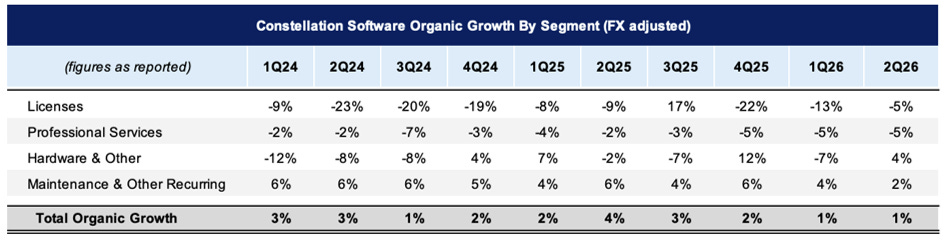
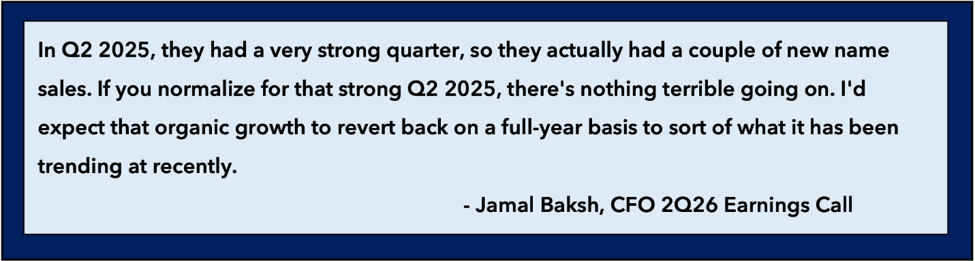
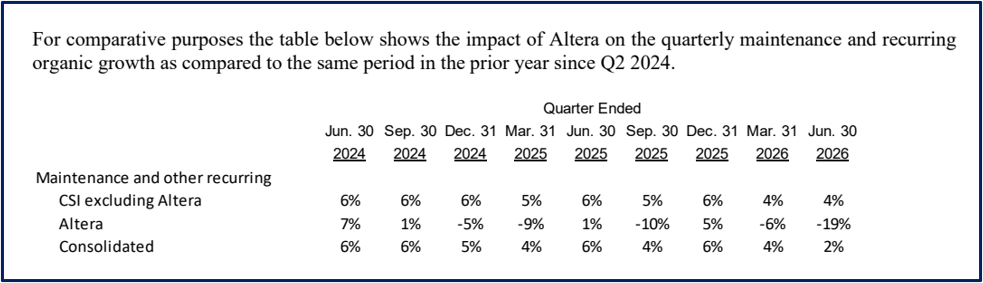
Their maintenance & other recurring revenues (which is the best barometer of the health of their core software business) grew 2%, which is a -200bps deceleration q/q and the lowest since Covid 4Q20. Management attributed this deceleration to Altera, which had benefited from a $17mn non-recurring revenue bump in 2Q25, so this was a tough comp. Management noted that if you backed out this impact, maintenance and recurring organic growth would’ve been 4%. There were a few other anomalies mentioned on the call that adjusted out would have brought them closer to 5%.
Since they acquired Altera through its purchase of Allscripts back in May of 2022, it has since generated $400mn of cumulative free cash flow, while revenues have shrunk to ~$646mn LTM. But despite this revenue decline, management mentioned that Altera’s IRR is still tracking ahead of their original investment estimates. This is a fairly typical investment for Constellation Software, who often buys businesses that are not growing much (or shrinking), but at such a cheap price the return math works. They do expect Allscripts to stabilize in the next year or so, though.
Overall, the 1% total organic growth is within their normal range of expectations (our original report estimated 0-2% long-term). While an acceleration of growth would have been nice to see, their organic growth rate has been stuck around ~2% for years. While we were optimistic that some of their AI initiatives they talked about at the AGM would translate into revenue growth already, especially since many SaaS companies seemed to have already benefited from surcharging for basic AI features, that hasn’t happened yet.
On the call, Mark Miller noted that there are signs that AI is improving productivity across the company, and they are working with customers to sell potential add-ons, but the benefit of these actions will not show up in organic growth in the short term.
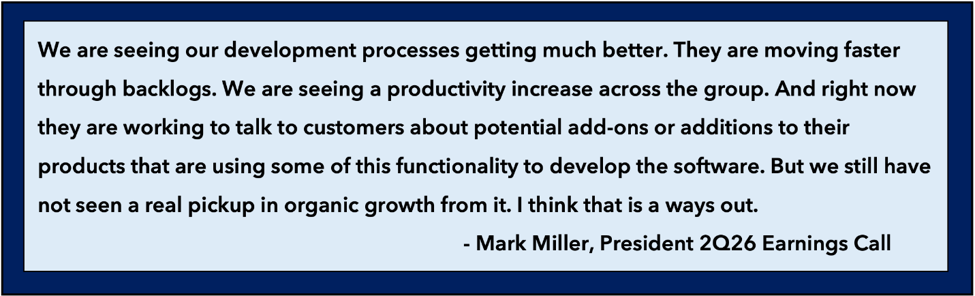
These results illuminate a difference from their small business end customers vs other software company’s larger enterprises who are more willing to experiment with AI spend. Miller notes that the AI features they roll out need to have a clear benefit for the end user— and essentially sell themselves. While they can build products faster, justifying the use cases for those products to customers is no easier than in the past.
As Mark said, “You can build products fast, but selling them is a whole other thing. A customer has to budget for them, and you have to be solving a need that they’re willing to put some money on the table for before it’s going to impact our organic revenue growth.”
One potential speedbump here though is that Constellation is not a “build it and they will come” sort of company. Unless they have rare confidence in the salability of a feature, they typically wait for their customers to request something before building it. In this context it makes sense why AI hasn’t had much of an impact yet, as most small businesses wouldn’t know what to request from AI as the technology is so new. The AI products that are successful in the software market today are strongly pushed by the companies themselves, which is not how CSU operations.
Constellation does not have a centralized AI initiative run from their headquarters, instead each business unit is responsible for their own AI development, funding from their own P&L. While this has prevented a lot of R&D experimentation in the past, it does ensure investment is less likely to be wasted. One of the positive benefits for CSU from AI though is that it greatly lowers the cost to launch features, so that should help encourage some more product development than otherwise.
Instead of going on the offense with AI though, the strategy is to be a faster follower. If a horizontal AI company comes into one of their verticals, now with AI, they can be quick and adopt what is working for that company and use that to improve their businesses within that vertical.
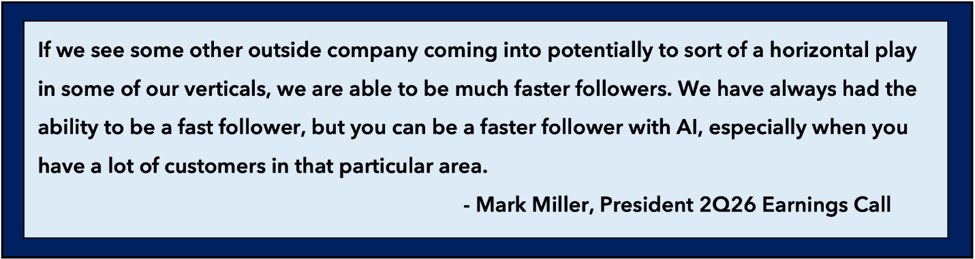
It is also worth mentioning that Mark Miller opened the call saying that “we are not going to give you an AI target, an AI revenue line or an AI time line. If we start reporting a number like that, we will start managing to it”. We think this is very sharp and in typical Constellation fashion.
Turning to capital deployed, CSU deployed $893mn in 2Q26 and have already deployed $818mn QTD so far, which puts total YTD capital deployment at ~$2.5bn. That is more than $1bn above their entire 2025 deployment, and they have the rest of the year to go. As we mentioned in our last update on CSU, this has been a big step up compared to the past two years. This is a good sign that they are continuing to find ways to deploy capital. However, they noted that they are not increasing their return expectations (hurdle rates) even though valuations are a bit soft: there is still plenty of competition. To the point, their acquisition of DerbySoft was purchased at a higher multiple (~4x revenues) than the typical 1-1.5x revenues historically. The higher price was justified by it “growing nicely” and use of some leverage, which nets to the same hurdle rate as other investments.
FCFA2S is the best indicator of owner earnings and FCFA2S (after backing out the IGRA liability) grew +18% y/y in 2Q26 and +12% y/y in 1H26. That puts LTM adjusted FCFA2S to ~$2.2bn. This doesn’t include their PEMS, or Permanent Engaged Minority Shareholdings, but their PEMS weren’t meaningful this quarter as it fell -$53mn q/q in investments in associates.
Overall, Constellation reported a good quarter as they showed no signs of AI disruption and strong capital deployment. At a current stock price of $2,215, Constellation has a market cap of $46.8bn. This puts them at a ~21x LTM FCF multiple for a company that has grown cash flows at a 14% CAGR since 2020.
For further reading, check out our Constellation Software Extensive Research Report.
The Synopsis Podcast.
Follow our Podcast below.
For those that are new to our podcast, we have four episode formats: “company” episodes that breakdown in-depth each business we write a report on, “dialogue” episodes that cover various business and investing topics, “article” episodes where we read our weekly memos, and “interviews”.

Become a Speedwell Research Member to receive our Airbnb report and all of our other research reports, business updates, and Plus Members also receive Excels.
We have covered APi Global, Appfollio, Airbnb, Axon, Casey’s, Constellation Software, Copart, Coupang, CoStar Group, Dream Finders Homes, Etsy, Evolution, Floor & Decor, Meta, Perimeter Solutions, Porsche, RH, and Walker & Dunlop, with many more coming each year!
(Many members have gotten their memberships expensed. If you need us to talk with your compliance department to become an approved vendor, please reach out at info@speedwellresearch.com).

*At the time of this writing, one or more contributors to this report has a position in CSU. Furthermore, accounts one or more contributors advise on may also have a position in CSU. This may change without notice.